LANDESMEDIENZENTRUM BADEN-WÜRTTEMBERG.
A model room for future-oriented learning
HELLO
LMZ
Exciting questions such as “What does the future of learning look like?” and “What role do location and space play in this learning?” require us to look beyond the current horizon. This is precisely the change of perspective that the “Future of Learning” department at the Baden-Württemberg State Media Center (Landesmedienzentrum, LMZ), headed by Stephanie Wössner, is initiating and shaping. The current project focuses on future-oriented learning in connection with spatial design. In order to create a solid foundation for this complex of topics, the staff unit has commissioned a study from Future:Project. It provides well-founded insights into the design principles for the future of learning and clarifies the framework conditions required for new forms of learning to work in practice.
DO IT
Stephanie Wössner comes to us with the results of the study, and we get started. The ideas are to be used to create an inspiring space at the Stuttgart location of the State Media Center that is much more than just four walls. Covering 130 square meters, it will provide new impetus and show what future-oriented learning can look like. Our task: to translate the expertise of the administrative department and the findings from the study into room design and individual interior construction, and then to make it a reality with our own craftsmen. No sooner said than done: welcome to the model room for future-oriented learning.
SHIFT!
New learning requires a different understanding of space
Functional classrooms, noisy hallways, lessons at fixed intervals—for many people, this immediately conjures up a clear image of school.
Future-oriented learning looks different: it understands learning as an active creative process—both individually and socially. It is more flexible, more diverse, and consistently geared toward self-determination, responsibility, participation, and co-creation. For this to succeed, spaces are needed that facilitate this attitude: places for concentrated work as well as for exchange, experimentation, retreat, and collaborative thinking.
The model room offers insights into how this can look within four walls, but as part of its educational concept, it also suggests that it should deliberately not be limited to rooms in the classic sense of four walls. Learning is understood as part of the urban, social, and cultural fabric.
Educational processes are embedded in real contexts, encounters, and questions about the future—in the city, in public spaces, in hybrid and digital environments. This means that the model space is just one of many places where future-oriented learning can take place and the future can be shaped.
Interior design thus becomes an active part of the learning culture. It shapes how people learn, work, take responsibility, and shape the future together.
Before we get into the concrete planning, our project team will take part in a two-day design thinking workshop. Organized by Future:Project and the “Future of Learning” department and supported by the Ravensburg District Media Center, it brings together learners aged 6 to 66, learning facilitators, school administrators, school authorities, and experts in design and education. Together, they discuss what is needed for good learning and how interior design can contribute to its success.
TO THE SURFACE
From classroom to
learning environment
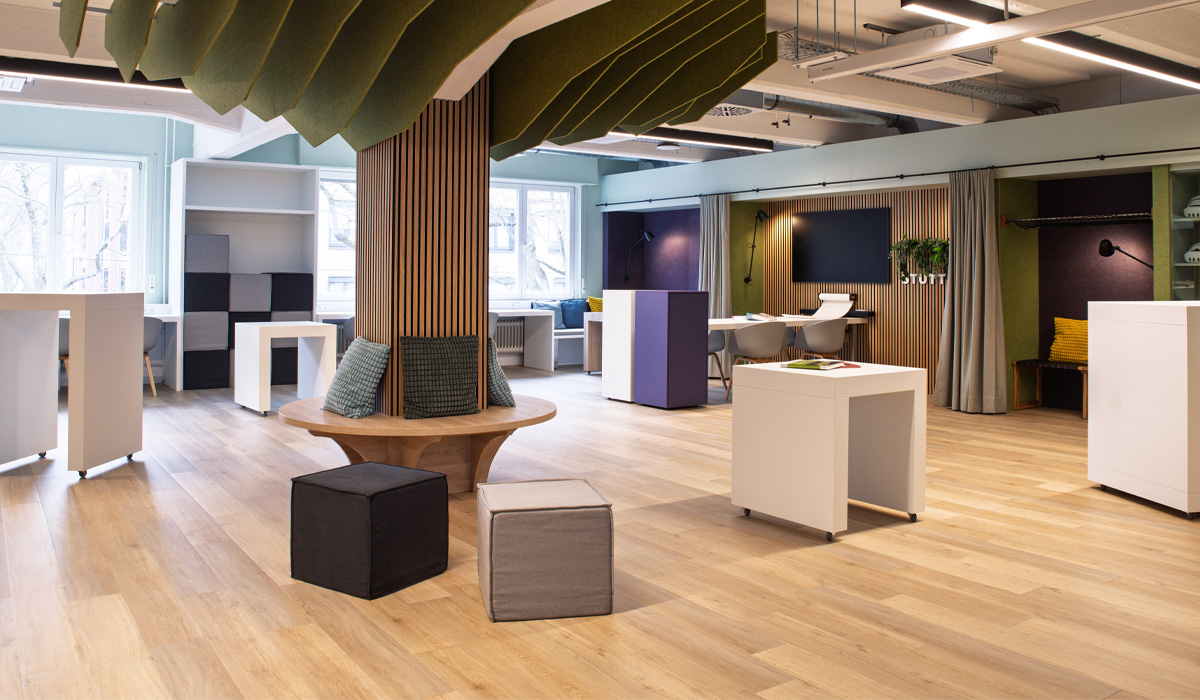
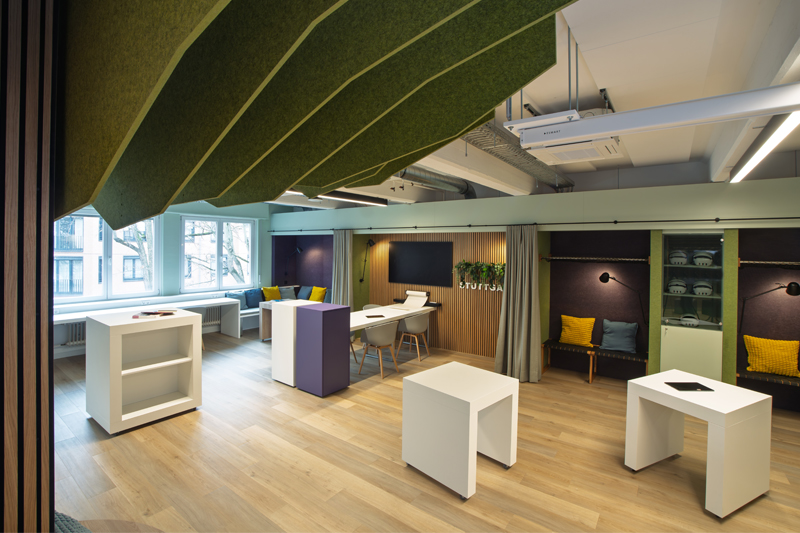
Our concept translates the insights gained from the design thinking process into a clear spatial concept. Structure and flexibility meet an atmosphere that facilitates concentration while inviting exchange and learning.
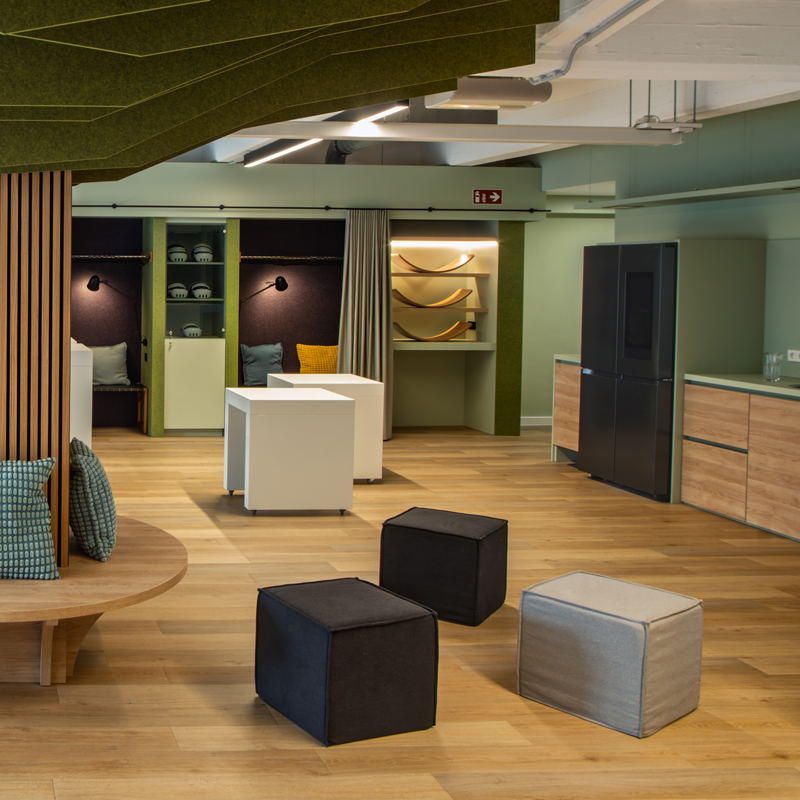
In terms of design, this learning environment is created through a finely tuned interplay of color, material, and light. A light, friendly sage green creates calm and cohesion, while the contrasting plum tone adds accents and provides orientation. Wood in the interior design and furnishings brings warmth and a natural feel. At the same time, the room remains clear and tidy: all technical elements are fully integrated into the interior design.
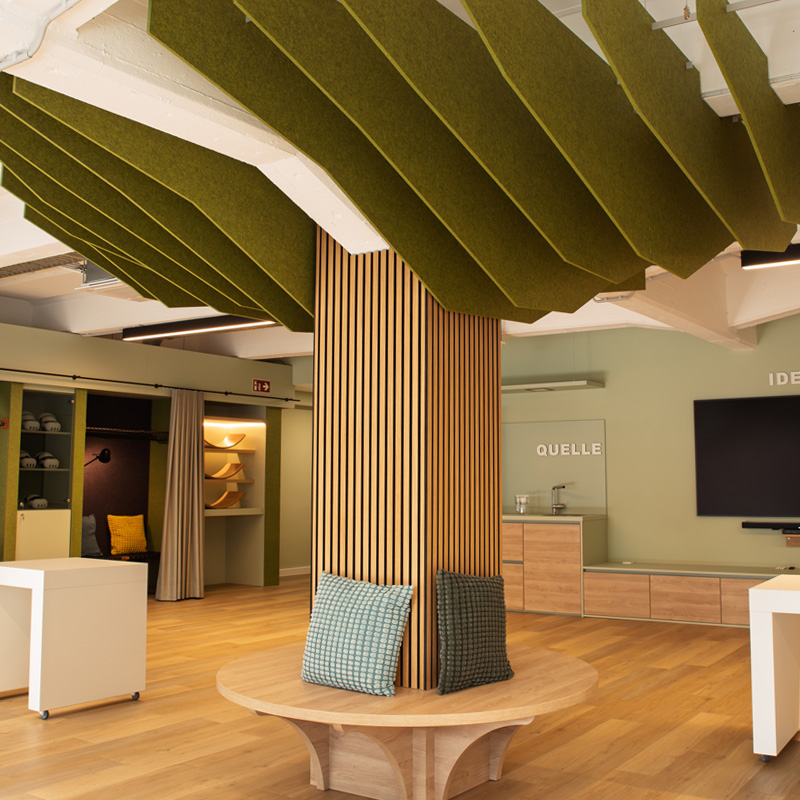
The tree in the middle subtly creates a connection to nature outside the window, where large trees also stand. This symbolically opens the room to the outside world and makes it clear that there are no real boundaries for future-oriented learning.
DEEP DIVE
Focus zone –
learning to the point
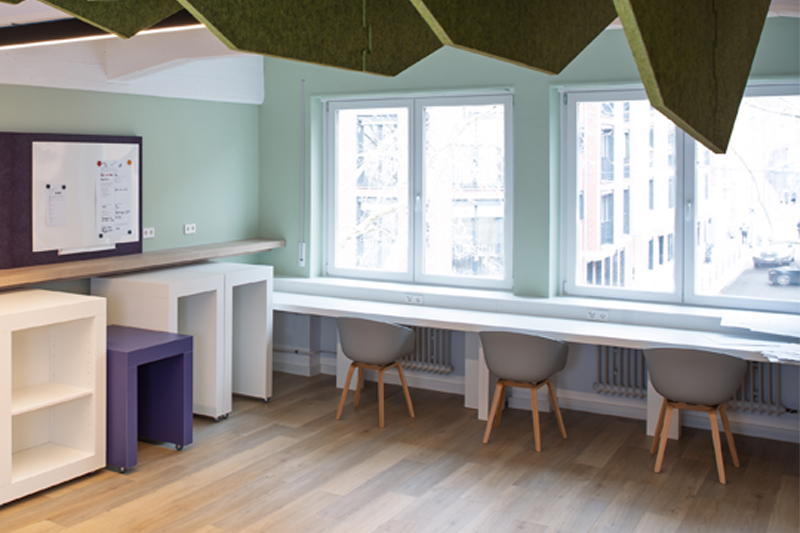
Those who want to concentrate on their work will find a quiet place at the long table by the window. The minimalist surroundings and the view of the greenery enable concentration, distance, and promote clarity.
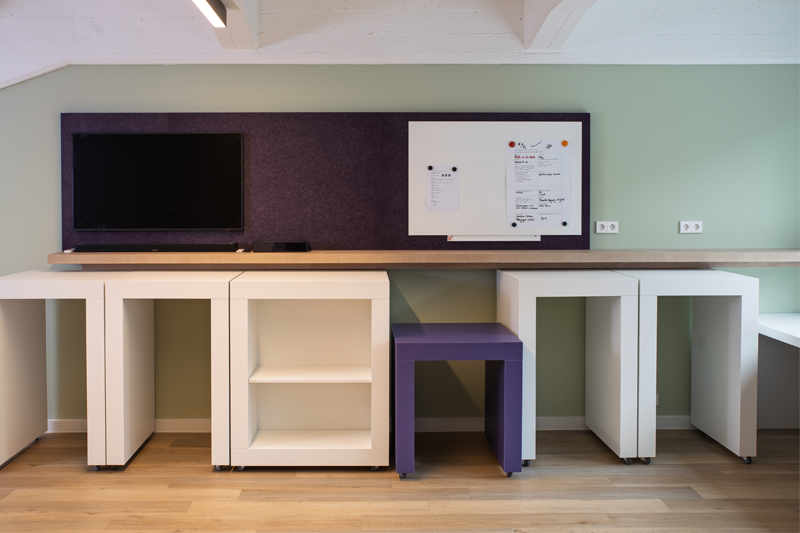
This shows that inclusion is an integral part of the room concept: recessed table legs deliberately create space in the lower area. This means that everyone can sit comfortably – regardless of their height, sitting position, and mobility.
TIME FOR YOU
Small niches –
places to travel
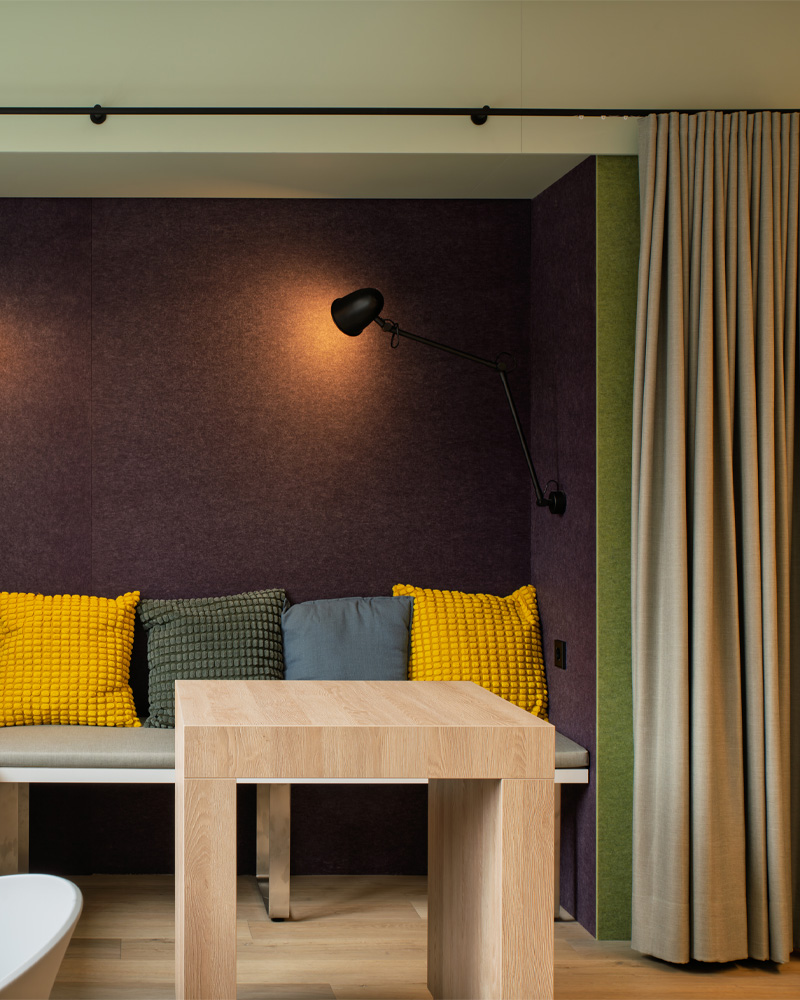
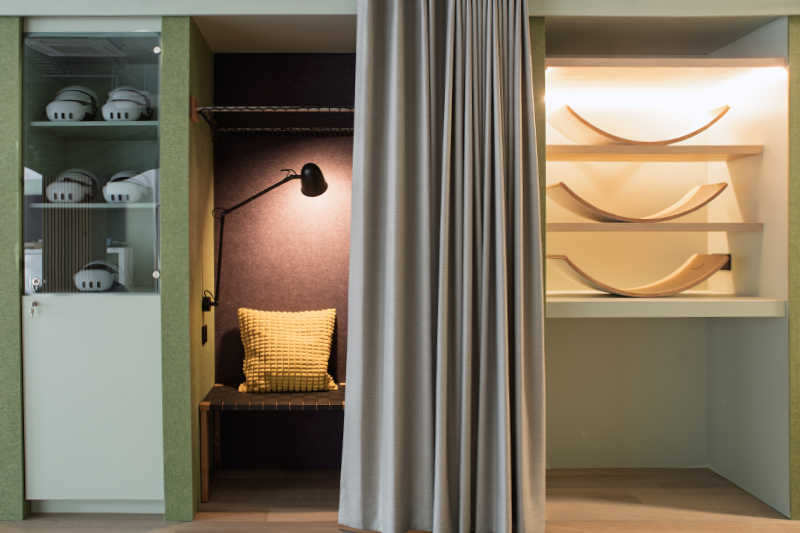
“All aboard. Curtains up. Let's go.” The small, cozy niches give visitors the feeling of sitting in a quiet train compartment. Shielded from the hustle and bustle and traveling at their own pace, they can immerse themselves in their own world and find peace.
Our interior designer was inspired by childhood memories of traveling in a sleeper car: luggage nets on the “car ceiling,” storage space for shoes and backpacks under the berth, the acoustic curtain closed, and the space opening up for peace, concentration, and creative thinking. This is especially valuable for neurodiverse individuals who need conscious breaks.
ENJOY TOGETHER
The tree of voices
Epic stories arise around campfires or under trees. Wherever people sit together, listen, and share experiences.
In the model room, the tree is the central element. It is the focal point, providing orientation and a place for encounters. Learners gather on the individually crafted benches made of light wood to exchange ideas, settle in, and continue thinking together.
In the educational concept, it is a “Tree of Voices,” a place where you can listen to voices and stories from the future, recorded by the people who have visited and used the room.
The materials and acoustics create a sense of calm and security. Wooden acoustic panels form the “trunk” and bring warmth to the room. In the “crown,” green acoustic surfaces reduce sound and support a calm, pleasant atmosphere.
OPEN UP
Cooperation Island –
stay flexible
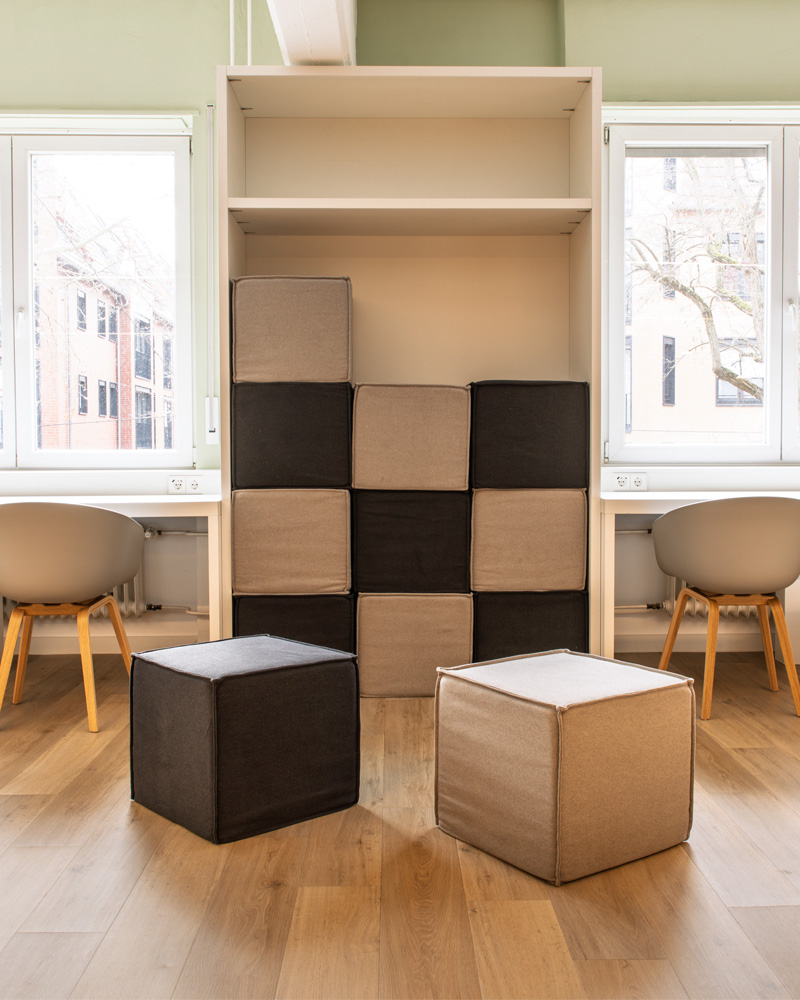
A step to the side, a different perspective, a new conversation. The Cooperation Island invites you to change positions. The tables can be flexibly combined, the colorful seating cubes can be arranged individually, and the surfaces can be used in different ways.
After the joint session, the seating cubes can be quickly stowed away in the designated cabinet, freeing up the space for the next learning experience.
CREATE TOGETHER
Stage of ideas –
Room for everyone
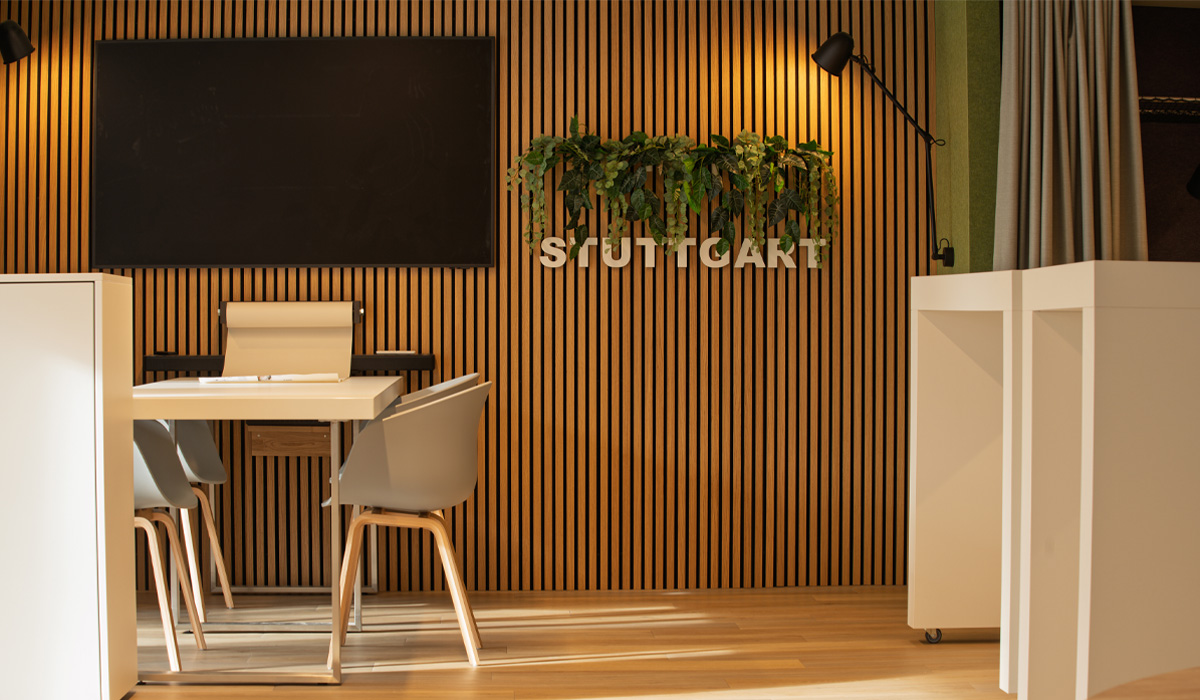
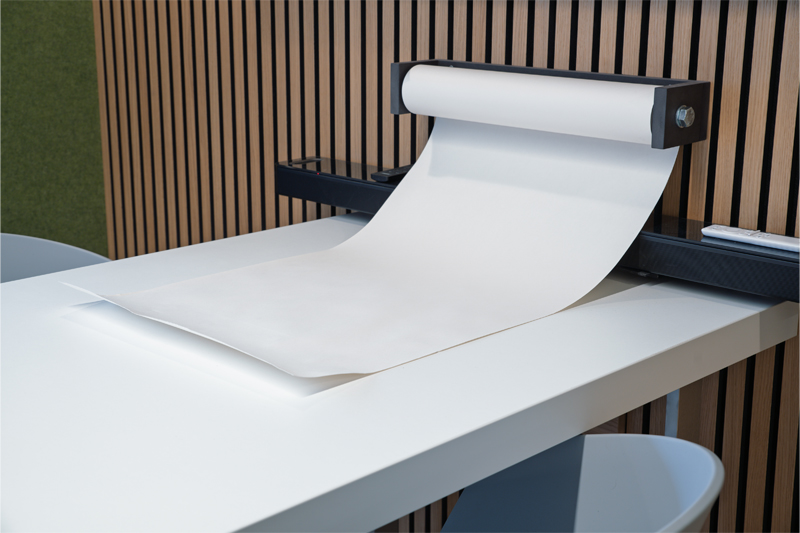
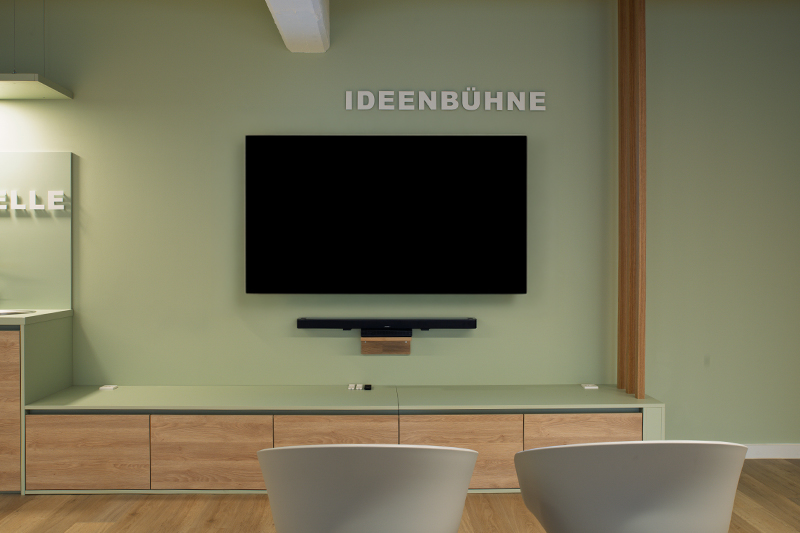
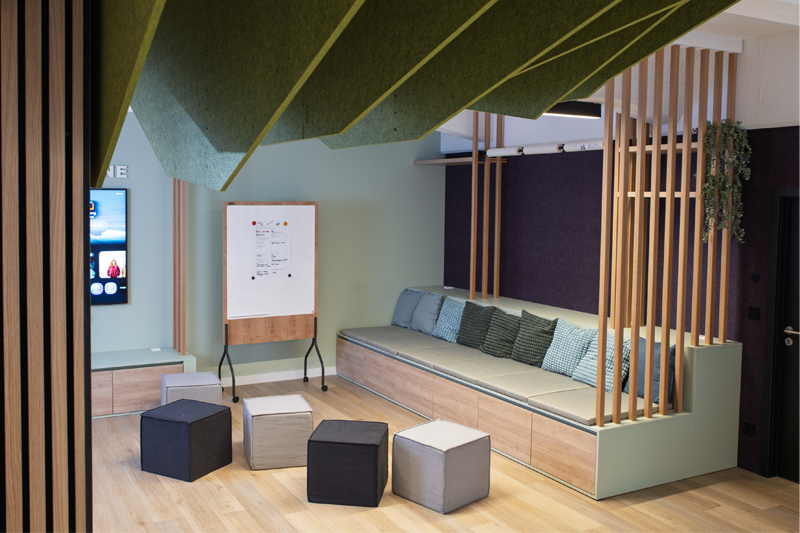
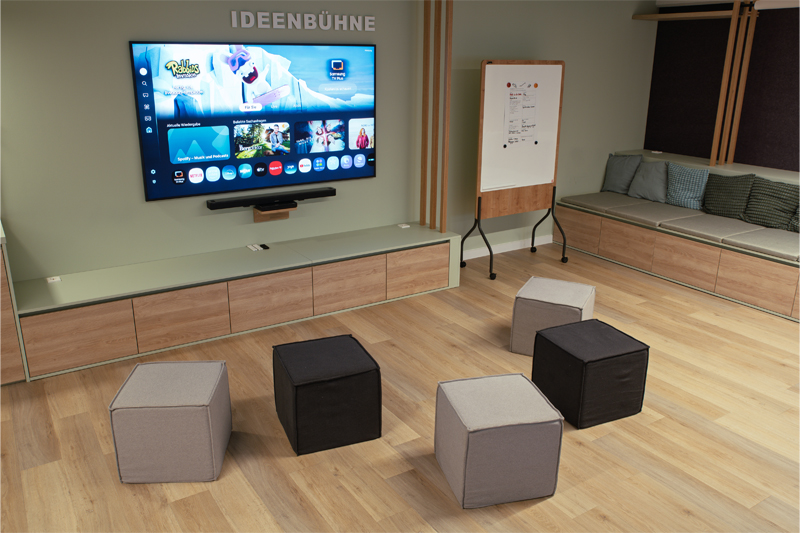
Learning is most successful when ideas are shared and developed further. The ideas stage offers space for presentations in many forms – from short updates to detailed results. A screen is available if required, but magnetic whiteboards and physical models also have their place on the ideas stage.
Directly connected to the Ideas Stage is a two-level gallery and an extendable screen for the ceiling-mounted projector. Opposite the ideas stage is the tree. This creates an area that deliberately breaks with traditional frontal teaching. In addition to short inputs, the open arrangement creates a conversation situation at eye level, allowing perspectives to be exchanged from different locations. This makes presenting feel less like a lecture and more like co-creation.
BEYOND THE PHYSICAL SPACE
Multidimensionality through technical possibilities
Instead of placing technology prominently in the room and giving the impression that technology determines learning, we focus on the discreet integration of technology in the model room. In other words, the technology is there, but it supports human relationships rather than replacing them. In this way, technologies become partners in the development of design skills rather than determining learning.
This allows learners to connect the physical world with digital and virtual worlds, which they do not merely immerse themselves in for the sake of consumption.
Rather, these expanded realities are spaces for creativity and possibility in which stories from the future are told. Educational concepts that come into play here include game-based learning and extended reality.
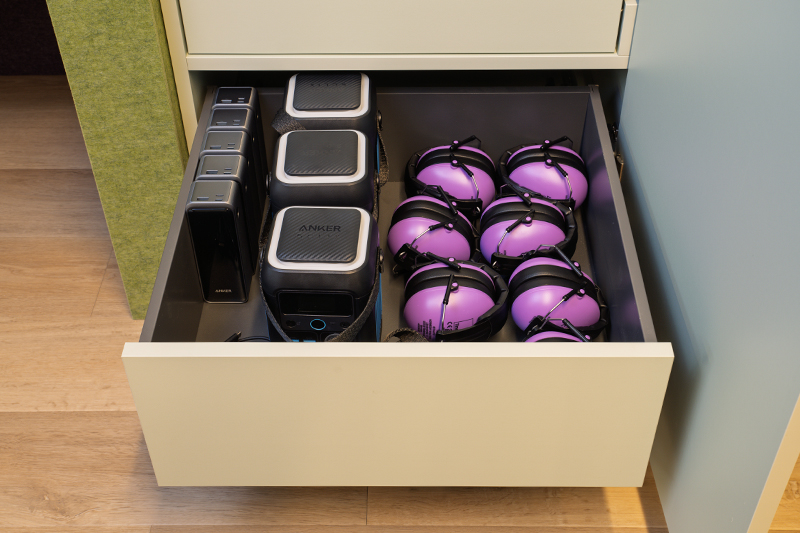
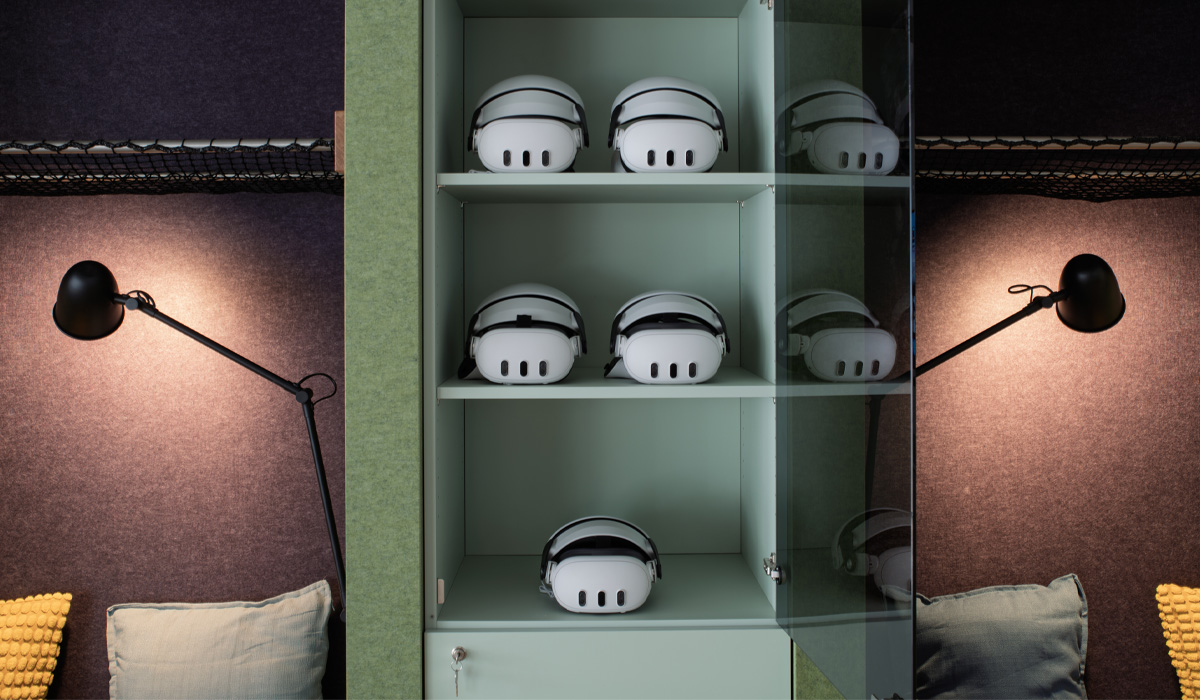
Technology such as mobile devices, screens, and VR glasses should be present without overloading the space or appearing dominant. That is why all technical elements are harmoniously integrated into the interior design—through color-coordinated paint, clear organization, and deliberately understated, partially hidden installations.
FLOW
Spring of life
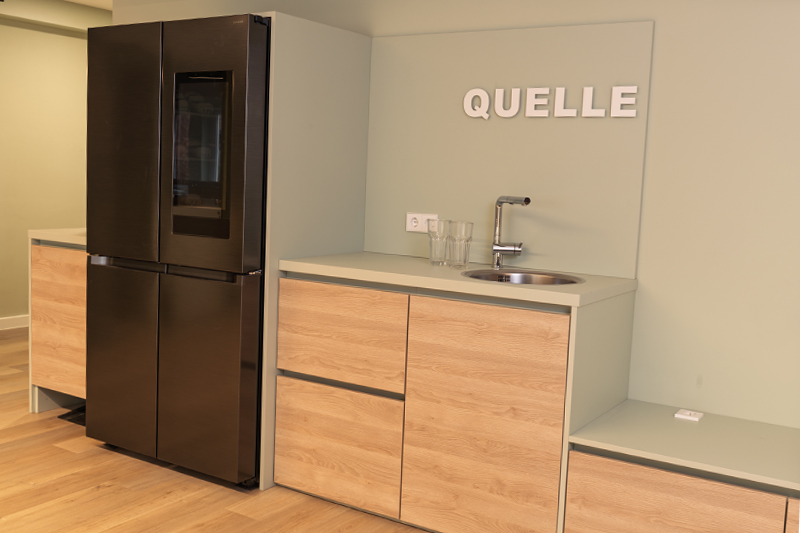
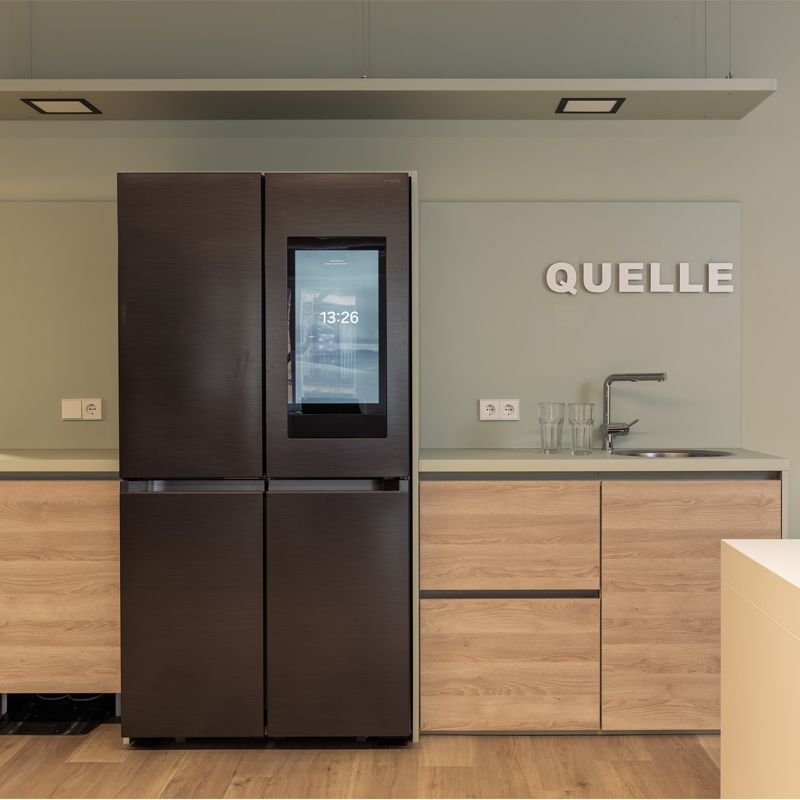
A balanced diet and sufficient water are part of learning – because only a healthy body can be creative. Snacks can be prepared and drinks refilled in the small kitchen. It is deliberately designed as a place for short breaks, where you can gather your thoughts and recharge your batteries.
Here, too, meaning lies in the details. Directly above the faucet is the word “spring”. A gentle reminder that we and the world around us are constantly in motion.
UNITY
Inclusion and diversity in practice
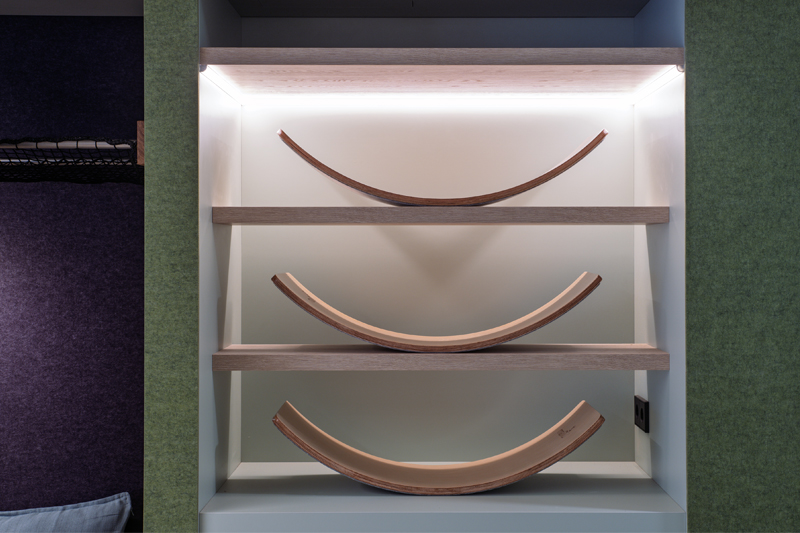
The interior design for inclusion and diversity is based on the key recommendations of the study “Where the Future Grows” and translates them into a concrete example. It shows how accessibility for all people can be supported spatially without claiming to fully reflect every conceivable situation. Essential elements include flexible seating, standing, and movement elements that meet different needs.
Curtains and protected areas create low-threshold opportunities for retreat. Barrier-free access and generous movement areas ensure that everyone can use the space independently. Since this is a space for everyone, there is deliberately no area where learning support staff are located. Instead, the boundaries between young and old are blurred, and support staff can also move around freely so that support becomes a natural part of everyday life.